


Richardson was, like many of the great writers of the early decades of this century (Joyce, Pound, Conrad), an expatriate. In Australia she is held in the mixture of respect and — resentment is too strong a word — regret with which expatriates are viewed in countries that have been outside the centers of power and must struggle for attention (one thinks, for example, of the mixture of pride and criticism with which some Argentines have viewed their great expatriate writer Julio Cortazar). She returned to her homeland only once after age eighteen, to do research for her writing. Dale Spender, in Writing a New World: Two Centuries of Australian Women Writers, says that "Henry Handel Richardson is a writer with an international reputation although whether . . . this is primarily because she chose to lead her literary life outside Australia, or whether it is a testimaony to the quality of her work, I cannot tell."26 Australian critic Vincent Buckley reported an acquaintance arguing that "Richardson does not see things as an Australian would,27 and nationalistic writer Miles Franklin said of the postwar trilogy, The Fortunes of Richard Mahony, "here at last was a work by an Australian in which the English-thinking Australians could take pride."28
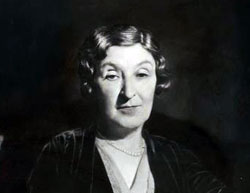 |
Henry Handel Richardson, date unknown |
Spender does agree with Nettie Palmer that "the way in which Henry Handel Richardson linked personality and setting had changed the direction of the novel."29 It is often a characteristic of expatriates to write with particular vividness of their homelands, and this Richardson does by intertwining setting and pyshcology with consummate subtlety. Indeed, Dorothy Green maintains that "There are few Australian novels which create an autonomous world and which at the same time convey a vision of metaphysical life, but Richardson's are among them, and . . . still supreme among them."30 And Leonie Kramer in her Oxford History of Australian Literature, calls Richardson "the first substantial Australian novelist to convey a large consistent vision of life." 31
continue reading (conclusion) . . .
***
This essay was the introduction to the 1993 Mercury House reissue of The Getting of Wisdom.
return to beginning
previous page
conclusion
***
***
Notes
26 Dale Spender, Writing a New World: Two Centuries of Australian Women Writers (London: Pandora, 1988), 245.
return to text
27 Buckley, 5.
return to text
28 Cited in Leonie Kramer, The Oxford History of Australian Literature (Oxford: Oxford University Press, 1973), 22.
return to text
return to text
30 Dorothy Green, Ulysses Bound: Henry Handel Richardson and Her Fiction (Canberra: Australian Natioinal University Press, 1973), 22.
return to text
31 Kramer, 96.
return to text
home | © 1993 by Thomas Christensen