


For this edition we have joined The Getting of Wisdom with full-color peproductions of paintings by Frederick McCubbin (1855-1917). McCubbin, a fine draftsman with a classical sense of composition, had been painting since the 1870s, when he studied painting in the Melbourne National Gallery School. In 1885 he founded the Box Hill artists' camp, in a suburban setting outside Melbourne that may recall Laura Rambotham's origins. Alan McCulloch writes of Box Hill:
The name of the suburb, which lay about twelve miles east of Melbourne, derived from the rich stands of red-box, or blue-gum as it is commonly known, a fast-growing species of eucalypt with a broad, milky blue leaf which is particularly beautiful at the sapling's stage of the tree's growth. . . .
To all the artists who participated in the activities there, the box hill camp, the setting, the talk, the campfires and the comradeship, became symbols of a way of Australian life and an unforgettable memory and solace in later life. McCubbin in particular remained faithful to the blue-gum country of Box Hill for the rest of his life. The physical setting, tinged as it was with strange melancholy, provided the backgrounds for many of his most famous pictures.32
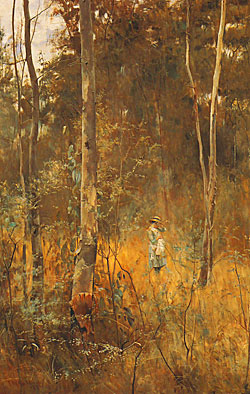 |
Frederick McCubbin, Lost (The Lost Child), 1886, oil on canvas |
Thus McCubbin's art was rooted in nearly the same native soil as Richardson's writing. But, like her, he benefited from the stimulus of European artistic traditions to develop his vision fully. (Both moved from naturalism to impressionism. From her first work, a translation of Danish writer J. P. Jacobsen's Niels Lyhne, Richardson learned, she said, that naturalism in the novel must be only "an outer garment."33 "In her fiction, naturalism devolves towards psychological impressionism, so that she may hint at the workings of inner life";34 this may also be said of McCubbins art.) It was not until his one and only trip to Europe in 1907 — just as Richardson was completing her first novel, and working on The Getting of Wisdom — that he began to adopt his distinctive impressionistic later style, featuring smaller canvases and techniques closer to those of the French Impressionists. Unlike other Australian Impressionists, McCubbin was less interested in bright sunlight effects than in embuing his scenes with a certain (often somber or melancholy) mood. In this he recalls the literary correspondences of character and setting of Henry Handel Richardson. Both writer and artist, working in a tradition outside the mainstream, and sharing Melbourne as one of their subjects, merit more attention than they have recently received. Mercury House is proud to present this most beautiful edition ever of The Getting of Wisdom as the latest in our ongoing series of neglected classics in illustrated editions.
— Thomas Christensen
***
This essay was the introduction to the 1993 Mercury House reissue of The Getting of Wisdom.
return to beginning
previous page
***
***
Notes
32 Alan McCulloch, The Golden Age of Australian Painting: Impressionism and the Heidelberg School (Melbourne: Landsdowne Press, 1969), 22.
return to text
33 Niels Lyhne has recently been published in a new English translation by Tina Nunnally in a fine edition from Fjord Press (Seattle, 1990). Richardson worked from her knowledge of German and a Danish dictionary.
return to text
34 Kramer, 84.
return to text
home | © 1993 by Thomas Christensen